Only One EPA Web Resource Has Been Restored — Entirely Scrubbed of Climate Change Content

Only One EPA Web Resource Has Been Restored — Entirely Scrubbed of Climate Change Content

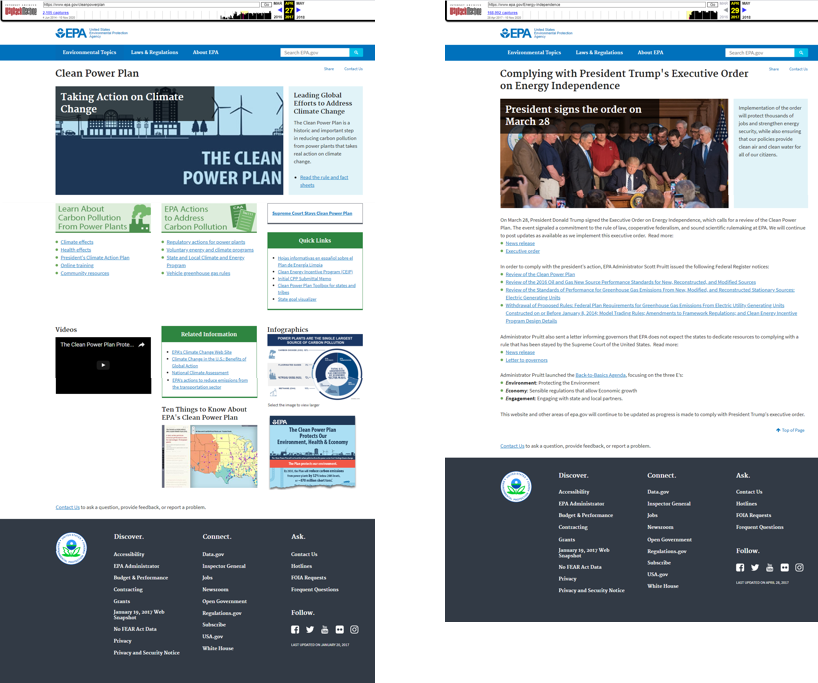
The “Climate and Energy Resources for State, Local, and Tribal Governments” website (left) was replaced with the “Energy Resources for State, Local, and Tribal Governments” website (right), which omitted all climate information. Welcome! This post is part of the EDGI Website Monitoring Team’s “Change of the Week” blog series. The purpose of this series is … Read more

Change of the Week: Story of Clean Power Plan Website Removal Underscores Need for Better Information Policies

Change of the Week: Story of Clean Power Plan Website Removal Underscores Need for Better Information Policies

This week’s change of the week was made in April 2017 and features the redirecting of the EPA’s Clean Power Plan website to a single webpage about a 2017 executive order on “energy independence.” We discussed this issue in our 2018 public comment on the proposed repeal of the Clean Power Plan, and it underscores the urgent need to develop better web resource policies. 

Democratizing Data Reports Released by EDGI’s Environmental Enforcement Watch

Democratizing Data Reports Released by EDGI’s Environmental Enforcement Watch

Seventy-six congressional report cards released by Environmental Data & Governance Initiative’s Environmental Enforcement Watch on October 22, 2020, show a decline in compliance and enforcement for key U.S. environmental laws under the Trump administration. The report cards are summarized in the new report, Democratizing Data: Environmental Enforcement Watch’s Report Cards for Congressional Oversight of the EPA, which provides for the first time an analysis of Environmental Protection Agency data on compliance and enforcement in the districts and states of the representatives and senators serving on the two congressional committees tasked with overseeing the Environmental Protection Agency.

Making a public dataset: reviewing and reclassifying changes to federal environmental webpages

Making a public dataset: reviewing and reclassifying changes to federal environmental webpages

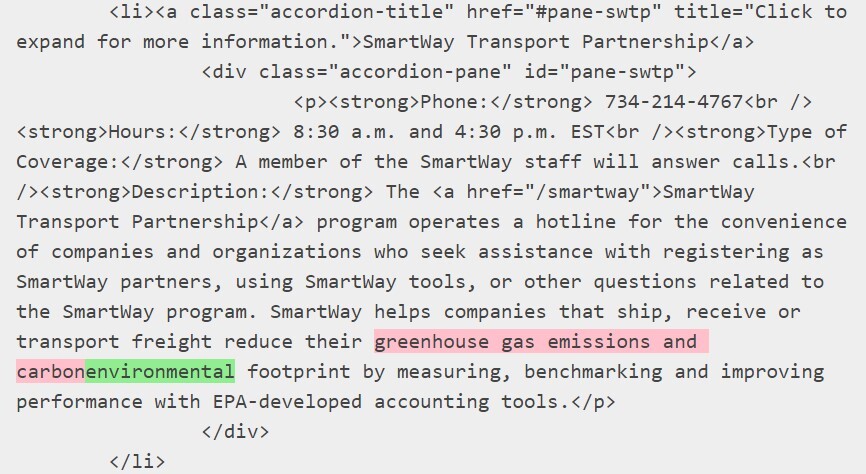
Blog written by Alejandro Paz Lead image shows the HTML source code comparison for two versions of the same page, on which “greenhouse gas emissions and carbon footprint” was changed to “environmental footprint.”  Making a Public Dataset For the past three and a half years, EDGI has been monitoring U.S. federal agency environmental webpages and … Read more

Change of the Week: It’s the two-year anniversary of EPA abandoning its Climate Change website “updates”

Change of the Week: It’s the two-year anniversary of EPA abandoning its Climate Change website “updates”

Welcome! This post is part of the EDGI Website Monitoring Team’s “Change of the Week” blog series. The purpose of this series is to highlight interesting changes we have observed in the language used on, or access to, federal websites. We want to share these changes to encourage public engagement with and discussion of their … Read more

Change of the Week: Stripping information and stripping protections for migratory birds

Change of the Week: Stripping information and stripping protections for migratory birds

Welcome! This post is part of the EDGI Website Monitoring Team’s “Change of the Week” blog series. The purpose of this series is to highlight interesting changes we have observed in the language used on, or access to, federal websites. We want to share these changes to encourage public engagement with and discussion of their … Read more

Change of the Week: Coronavirus website downplays need for testing

Change of the Week: Coronavirus website downplays need for testing

This post is part of the EDGI Website Monitoring Team’s “Change of the Week” blog series. This week’s change was made in late August 2020 and features the addition of recommendations regarding whether or not to get tested on the Symptoms and Testing FAQ page of the federal Coronavirus website, created in March 2020 as a collaboration among the White House, CDC, and FEMA (and previously DHHS).

Bio-Lab’s Toxic Record Presages Chlorine-Fueled Fire Following Hurricane Laura

The blaze at Bio-Lab following Hurricane Laura was not the first release of toxic chlorine from the facility, EDGI’s research into available federal data finds.

As Hurricane Laura tore through Louisiana on the morning of August 27th, a chemical manufacturing facility called Bio-Lab, located in Westlake, caught fire. The facility manufactures chlorine for swimming pools and other cleaning agents. A chlorine leak ignited, setting the facility ablaze. Massive clouds of chlorine gas plumed over Westlake for more than 24 hours, prompting the governor of Louisiana, John Bel Edwards, to implement a shelter-in-place order for residents living in the vicinity.

Change of the Week: Any idea why fighting wildfires is getting harder?

Change of the Week: Any idea why fighting wildfires is getting harder?

This week’s change was made in June 2017 and features the removal of the only sentences about climate change on the U.S. Forest Service’s Wildland Fire webpage. What happened? In the middle of wildfire season, June 2017, the U.S. Forest Service (USFS) deleted the only sentence on its “Wildland Fire” webpage that mentioned the reasons that fire seasons have become longer and more intense, “This is due to a variety of factors, including climate change, buildups of flammable vegetation, insect and disease infestations, nonnative species invasions, and increasing numbers of homes and communities in the WUI…”