
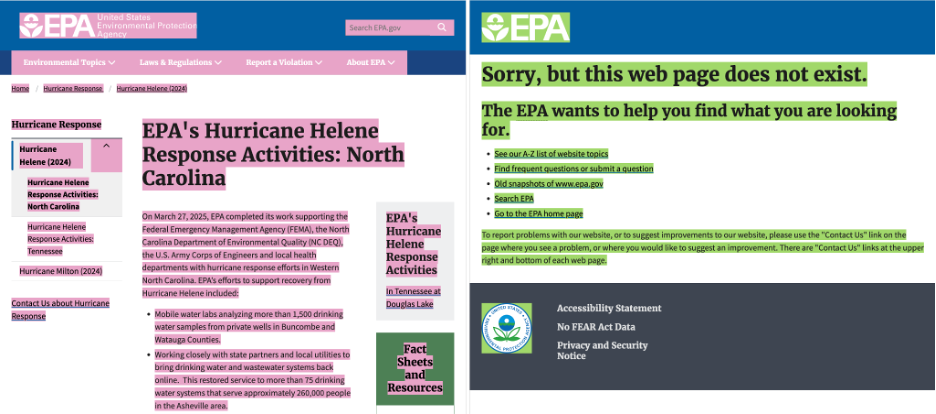
EPA’s Hurricane Helene Response Page on April 11, 2026 (left), and April 16, 2026 (right), after it was taken down.
Highlights From the Change Log:
Information About Historic Hurricanes Removed From EPA’s Website
Welcome! This post is part of the EDGI Website Governance Team’s “Highlights from the Change Log” blog series. The purpose of this series is to highlight interesting changes we have observed in the content of, or access to, federal websites. We want to share these changes to encourage public engagement with and discussion of their significance, as well as understanding of the ephemeral nature of website information. These website changes happened in April 2026 and feature the removal of information about Hurricanes Helene and Milton.
As we move into hurricane season this year, we will be doing so with less historical disaster information available to the public. In April 2026, EPA deleted all informational pages related to Hurricane Helene and Hurricane Milton. While these hurricanes occurred in 2024, there are many reasons why communities, disaster response professionals, researchers, and more would benefit from continued access to this hurricane response information.
Deletion of Hurricane Helene and Milton Pages
In April 2026, EPA’s main page for Hurricane Helene was deleted, alongside all other EPA pages related to the September 2024 Category 4 storm that were not news releases. This home page previously offered an overview of the storm and detailed EPA’s emergency response efforts. The page linked to several resources, including information about recovery progress, EPA’s hurricane resources, and news.
EPA also removed pages for “Hurricane Helene Response Activities: North Carolina” and “Hurricane Helene Response Activities: Tennessee.” Previously, these response pages provided detailed information on EPA’s collaboration with federal, state, and county agencies to support recovery. The detailed information on these pages pointed to specific actions or technical support that EPA was providing, as well as details on water sampling and public health outreach efforts.
Similarly, EPA’s main page for Hurricane Milton was also taken down. Previously, this page described the October 2024 Category 3 storm as well as EPA’s partnerships on emergency response and recovery efforts, and it linked to important FEMA resources on the storm and to several EPA resources for flooding cleanup.
Access to Prior Hurricane Information
Historically, EPA’s Hurricane Response homepage provided a linked list of “EPA Response” to prior hurricanes. Users could select a hurricane of interest from this list, and would be redirected to a response.epa.gov page providing extensive information about EPA’s response to that storm. The hurricanes would remain listed and linked under “EPA Response” on the homepage for roughly 2 years before being replaced with more recent storms. Once removed from the homepage, the response.epa.gov profiles for each storm would still remain online. This provided a system of archiving information about prior storms without fully removing access to them. For example, detailed response pages are still available today for Hurricane Harvey (2017), Hurricane Maria (2018), and Hurricane Ida (2021). While these hurricane response pages have banners warning that they are not being updated and are “considered inactive,” they are still available on EPA’s website.
The remaining availability of these older hurricane response pages stands in contrast to the Hurricane Helene and Hurricane Milton pages which have been fully removed, as opposed to being moved to the response.epa.gov domain and labelled inactive. These hurricanes simply were never given a response.epa.gov profile.
Who Decides What Information is Obsolete?
The removal of Hurricane Helene and Hurricane Milton information brings to light the question of who decides when and what information is obsolete. The EPA Web Guide, which governs the steps for review of EPA web content, notes that information is considered “obsolete” and may be removed when it is “not useful or relevant to the public.” However, access to information about prior hurricanes is used in future cases to inform resilience planning, provide feedback on water quality monitoring methods, exemplify hazardous waste management practices, and support community response efforts. Pages previously showed people how EPA was working in their communities, by detailing EPA’s direct efforts to support recovery, providing graphics on recovery metrics, and showing photographs of progress. EPA regional offices continue to put resources into creating disaster pages, demonstrating the ongoing need for these tools and histories online. Most recently, EPA’s Pacific Southwest Region published significant information about the Super Typhoon Sinlaku Response. Amongst other resources, the new EPA Response to Super Typhoon Sinlaku Storymap offers an excellent example of the wealth of information stored in these storm and disaster pages. Extensive data visualizations, photographs, videos, written content, and contact information remind us how significant storm and disaster response pages can be.
These informational resources are crucial for learning from past events. Removing public access to these pages wastes prior research, field work, and communications efforts. It undermines agencies’ ability to take lessons from prior response efforts and prevents communities from understanding the support they can receive from EPA. The fact that the storm has passed does not mean information about its response is obsolete; it means that we should now be able to learn lessons from it.
Removal of Other Disaster Information
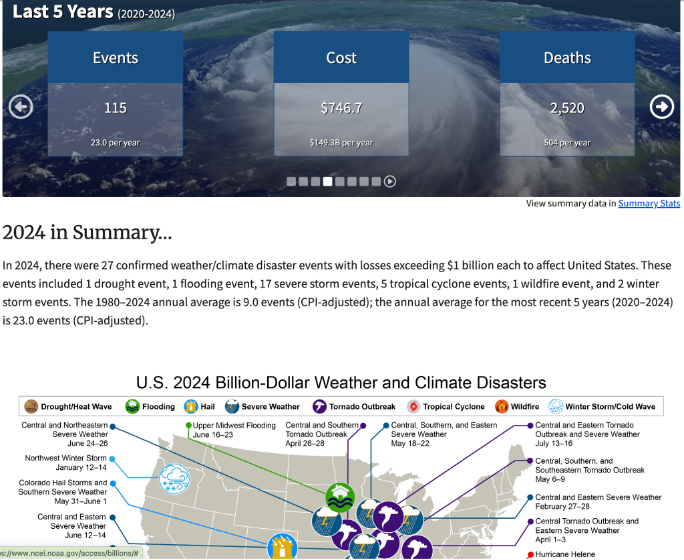
Removal of historical information about natural disasters has not been limited to hurricanes. In May 2025, the National Oceanic and Atmospheric Administration (NOAA) announced that its billion dollar disaster tracker would be decommissioned. Previously, this page provided event details, mapping, and costs of U.S. weather and climate disasters from 1980 onwards, where overall damages/costs reached or exceeded $1 billion. Ironically, two of the last such events to be included in the website were the same events removed from EPA’s website: Hurricane Helene and Hurricane Milton. With the tool being retired, audiences will lack a time series catalog of disasters.
Such removals obstruct our ability to keep tabs on extreme events. By removing or refusing to update disaster-related information, scientists and even local, state, or federal officials do not have the data and information to learn from prior events. Lack of disaster information impedes future disaster planning, including understanding trends and frequency, which can impact budgets, resilience building, and emergency/response planning.
Disaster Information is Essential
Historical disaster information is a fundamental tool for ensuring successful disaster response. Access to information on prior disasters helps local and federal agencies communicate and contextualize prior response efforts, establishes community understanding of how various agencies support recovery, and helps prevent all levels of government from repeating mistakes made in prior disasters. Considering the essential efforts that continue to be used to inform communities of responses to natural disasters, this information should remain online and accessible for all audiences to utilize in future disaster scenarios.