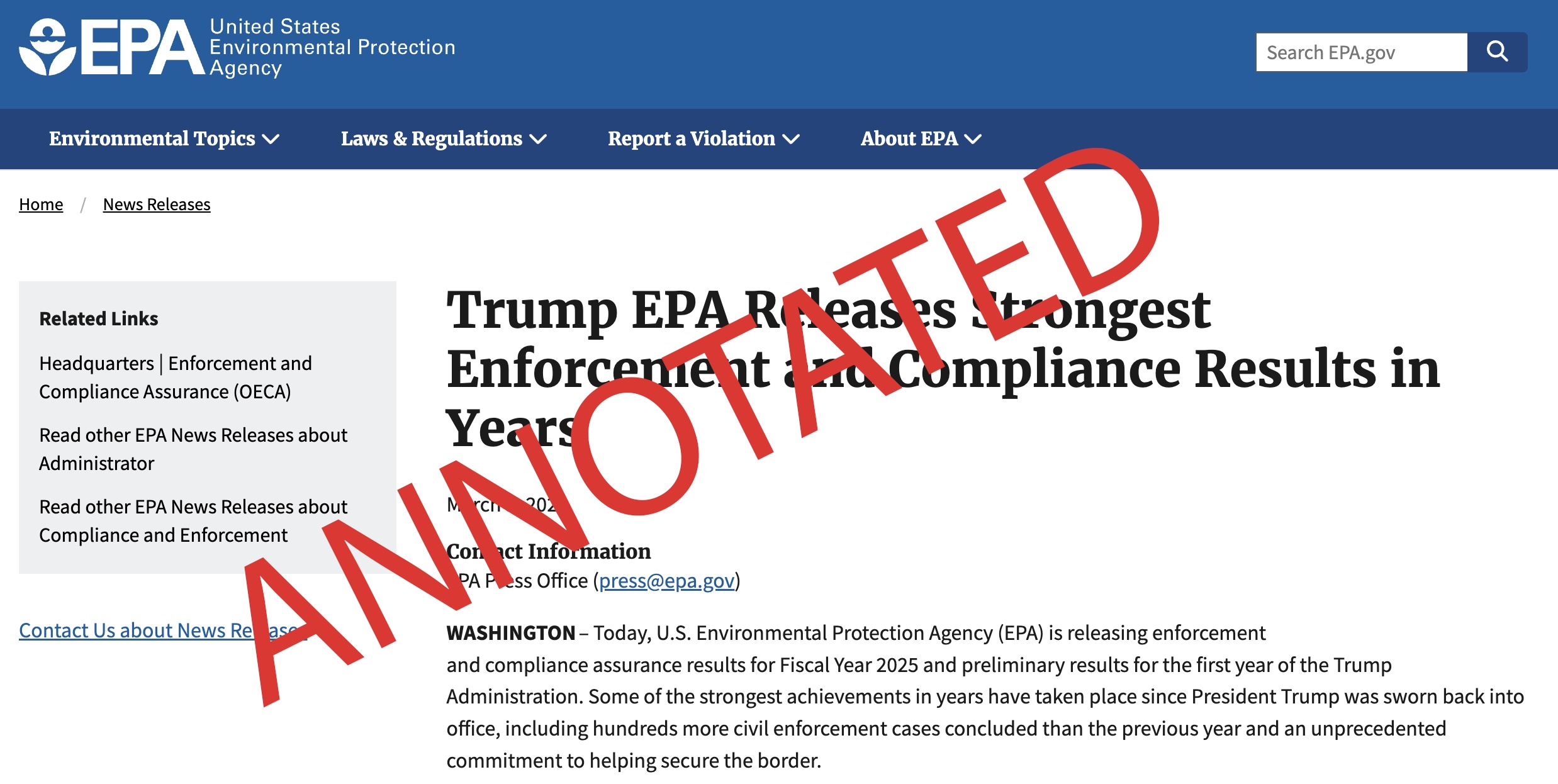
EDGI annotated a March 9, 2026, press release by the Environmental Protection Agency announcing the release of its Enforcement and Compliance Annual Results Report for Fiscal Year 2025. In this annotation, EDGI provides some important context and fact-checking for the public, journalists, and anyone interested in the EPA’s enforcement record.
The authors of this annotation are Christopher Sellers, Eric Nost, Kimberly Barrett, and Shannan Lenke Stoll.
Trump EPA Releases Strongest Enforcement and Compliance Results in Years
March 9, 2026
Comparatively speaking, March is late for the release of this report. Last year, the FY 2024 report was issued in December 2024. Examining report publication dates from FY 2015 onward reveals how uncharacteristically late the FY 2025 report was published.
Publication dates for The Office of Enforcement and Compliance Assurance Annual Results Report, FY 2015 – FY 2024:
- FY 2015: 12/16/2015
- FY 2016: 12/19/2016
- FY 2017: 2/8/2018
- FY 2018: 2/8/2019
- FY 2019: 2/13/2020
- FY 2020: 1/13/2021
- FY 2021: 1/20/2022
- FY 2022: 12/16/2022
- FY 2023: 12/18/2023
- FY 2024: 12/5/2024
Contact Information
EPA Press Office (press@epa.gov)
WASHINGTON – Today, U.S. Environmental Protection Agency (EPA) is releasing enforcement and compliance assurance results for Fiscal Year 2025 and preliminary results for the first year of the Trump Administration. Some of the strongest achievements in years have taken place since President Trump was sworn back into office, including hundreds more civil enforcement cases concluded than the previous year and an unprecedented commitment to helping secure the border.
“Strongest” is a misnomer.
- EPA has turned almost exclusively to administrative cases to go after polluters, even the worst ones, rather than taking polluters to court.
- Not only that, this EPA annual report fails to include any figures on the number of judicial cases initiated or concluded, and the agency no longer includes its criminal cases in its public enforcement database, Enforcement and Compliance History Online (ECHO). These moves constitute a historic retreat from transparency, covering its tracks as it backs away at once from the courtroom and from public accountability.
- The EPA under Trump is registering historic highs of leniency in the cases it does take up or conclude, both administrative and judicial (see annotations below).
- Agency boasting about administrative cases it has concluded obscures a larger pattern. Nearly across the board, the EPA is backing way from initiating key enforcement activities. Not only are initiated administrative cases far less that concluded cases; drop-offs have come in judicial cases against violators and in many of the inspections that enable it to detect violations in the first place (see annotations below). This pattern points to still more weakening of its enforcement in the months and years ahead.
For more, see the EDGI report, Making America Polluted Again: The Trump EPA’s 2025 Enforcement Record. For more on the agency’s historic retreat from the courtroom in particular, see reports from EarthJustice, Public Employees for Environmental Responsibility, and the Environmental Integrity Project.
Highlights from President Trump’s first year back in office include:
- Concluding over 2,300 civil enforcement cases, over 400 more than the final year of the Biden Administration and more than the last nine fiscal years.
These figures on case conclusions appear to be by fiscal year, which means that they also include work done in the final months of the Biden Administration. We’ve looked instead at EPA’s own publicly available data for the Trump administration’s calendar year (January 21, 2025, to January 20, 2026) and compared that to the same intervals for the first and fourth years of the Biden administration.
- The Trump administration concluded 3288 administrative cases, compared to 2,944 in Biden’s fourth and 2,659 Biden’s first year.
- However, Trump’s cases included over 400 more with zero dollars in federal penalties: 2,257 versus 1,813 for Biden’s year four and 773 for Biden’s year one.
- Moreover, the vast majority of cases concluded since January 21, 2025, rely heavily on earlier work, including inspections and the initiation of cases.
- To see how much the number of cases concluded under Trump may be attributed to work done at the agency under Biden and other predecessors, we analyzed the data EPA provides on the “inspection pipeline” for air pollution-related administrative cases. Of the 947 fully documented cases that were concluded January 21, 2025, to January 20, 2026 (about a third of the total case conclusions for that interval), 87% relied on inspections that happened before Trump took office for a second time.
Find our data here.
- Blocking over 1.6 million pounds of illegal pesticides from entering the U.S., a more than 70 percent increase over the last year of the Biden Administration.
While EPA boasts here about controlling pesticides, it also approved several pesticides that are highly persistent with scientifically established harms, including several agricultural poisons that include or break down into PFAS or “forever chemicals.” The EPA has also provided active support to pesticide manufacturers in court cases, such as those involving Bayer, a manufacturer of glyphosate and has dismissed scientific assessments by the World Health Organization that atrazine is “probably carcinogenic.”
- Obtaining sentences for 99 criminal defendants, more than the previous year.
Searching EPA’s Environmental Compliance History Online (ECHO) database for how many criminal cases the agency undertook in 2025 returns a result of zero. Unlike all other types of inspection activities, EPA has not made public any data on individual criminal cases since 2024. That has made anything the agency claims about its criminal case work impossible to verify or independently evaluate.
- Securing more than $6 billion in commitments to return facilities to compliance, nearly $1 billion more than the previous year.
We can’t tell where these totals came from. But what we do know, from looking at EPA’s public data, is that the total compliance costs for those administrative cases that the Trump Administration concluded between January 21, 2025, and January 20, 2025, were significantly less than those for Biden’s first or fourth years.
- Despite concluding more cases, the Trump administration required $2.477 billion in compliance costs, less than the $2.677 billion required by the Biden EPA between January 21, 2024, and January 20, 2025; and
- Both the Trump and final-year Biden figures ran lower that the $2.940 billion in total compliance costs in Biden’s first year, January 21, 2021, and January 20, 2022.
Find our data here.
- Securing commitments to clean up nearly 60 million cubic yards of contaminated land and water, almost 30 times more than the previous year.
Boding poorly for the future of such work, results from our recent report on EPA enforcement compared the public record of the first 10 months of the Trump administration (January 21 to November 30, 2025) with earlier years and found that the Trump EPA set a 20-year record for leniency in the number of solid and hazardous waste inspections finding violations under the Resource Recovery and Conservation Act (RCRA) (see Figure 14 in the report). Moreover, inspections under RCRA were the second lowest in 20 years, only higher in the first year of COVID (see Figure 13 in the report).
- Reducing, treating, or eliminating over 98 million pounds of pollution and waste.
- Assessing nearly $1.16 billion in civil penalties and criminal fines, restitution, and other court ordered relief.
The agency offers no comparison here between FY2025 and earlier fiscal years. So let’s compare, this time concentrating on time periods that do not overlap with Trump 2.0’s predecessor.
First, the fines levied in administrative cases concluded during the first year of the second Trump administration (counted from January 21 to September 30, 2025) with the comparable period in 2024 under Biden show the percent with zero fines has gone up from 59% to 66%. Find our data here.Then, comparing the total penalities imposed in administrative cases concluded during the same time periods under Biden (January 21, 2024, to January 20, 2025) and under Trump 2.0 (January 21, 2025, to January 20, 2026) also points toward greater leniency. The total of federal penalties fell from $68 million under Biden to $54 million under Trump, despite the Biden EPA concluding some four hundred fewer cases. Find our data here.
Finally, our recent report on EPA enforcement, comparing the public record of first 10 months of the Trump administration (January 21 to November 30, 2025) with earlier years, found that the Trump EPA has set 20-year records for leniency in the:
- Number of solid and hazardous waste inspections finding violations under the Resource Recovery and Conservation Act (RCRA) (see Figure 14 in the report);
- Percentage of EPA administrative cases filed with zero dollars in federal penalties (see Figure 22 in the report); and the
- Percentage of EPA administrative cases filed with zero dollars in compliance costs (see Figure 23 in the report).
- Conducting nearly 12,000 compliance monitoring activities.
Again, EPA only offers raw figures for a single year. That’s likely because a comparison with earlier years would yield poor results for this EPA and augur further declines in enforcement in the years ahead. Inspections and other compliance monitoring are the way EPA identifies violations it can then pursue through legal cases. Since these activities are so important for future enforcement actions, we’ve done the comparisons that EPA has not, between the first year under Trump 2.0, January 21, 2025, to January 20, 2026, and earlier years:
Inspections under the Toxic Substances Control Act (TSCA) severely decline from Biden’s first year to Trump 2.0’s first year:
- January 21, 2021 to December 31, 2021 (Biden’s first year) = 1,430 inspections
- January 21, 2024 to December 31, 2024 (Biden’s last year) = 1,284 inspections
- January 21, 2025 to December 31, 2025 (Trump 2.0’s first year) = 834 inspections
Inspections for lead paint (a subset of those under TSCA) severely decline after robust recent growth from Biden’s first year to Trump 2.0’s first year:
- January 21, 2021 to December 31, 2021 (Biden’s first year) = 272 inspections
- January 21, 2024 to December 31, 2024 (Biden’s last year) = 659 inspections
- January 21, 2025 to December 31, 2025 (Trump 2.0’s first year) = 405 inspections
Inspections under the Resource Conservation and Recovery Act (RCRA) for hazardous and solid waste significantly decline from Biden’s first year to Trump 2.0’s first year:
- January 21, 2021 to December 31, 2021 (Biden’s first year) = 2,055 inspections
- January 21, 2024 to December 31, 2024 (Biden’s last year) = 1,627 inspections
- January 21, 2025 to December 31, 2025 (Trump 2.0’s first year) = 1,410 inspections
Inspections under the Clean Water Act (CWA), combining those for the National Pollutant Discharge Elimination System (NPDES) program with other CWA programs, decline after robust recent growth from Biden’s first year to Trump 2.0’s first year:
- January 21, 2021 to December 31, 2021 (Biden’s first year) = 2,089 inspections
- January 21, 2024 to December 31, 2024 (Biden’s last year) = 3,194 inspections
- January 21, 2025 to December 31, 2025 (Trump 2.0’s first year) = 3,111 inspections
Overall inspections under the Clean Air Act (CAA) decline after significant recent growth from Biden’s first year to Trump 2.0’s first year:
- January 21, 2021 to December 31, 2021 (Biden’s first year) = 1,755 inspections
- January 21, 2024 to December 31, 2024 (Biden’s last year) = 1,897 inspections
- January 21, 2025 to December 31, 2025 (Trump 2.0’s first year) = 1,662 inspections
Partial inspection activities (often to check for particular pollutants of concern) under the CAA severely decline from Biden’s first year to Trump 2.0’s first year:
- January 21, 2021 to December 31, 2021 (Biden’s first year) = 761 inspections
- January 21, 2024 to December 31, 2024 (Biden’s last year) = 790 inspections
- January 21, 2025 to December 31, 2025 (Trump 2.0’s first year) = 582 inspections
Full inspection activities under the CAA decline after robust recent growth from Biden’s first year to Trump 2.0’s first year:
- January 21, 2021 to December 31, 2021 (Biden’s first year) = 92 inspections
- January 21, 2024 to December 31, 2024 (Biden’s last year) = 214 inspections
- January 21, 2025 to December 31, 2025 (Trump 2.0’s first year) = 199 inspections
All data from March 11, 2026, search of ECHO database, last updated on March 8, 2026.
“The days of using EPA’s enforcement arm to pursue overzealous prosecution and partisan agendas are over. The Trump EPA is bringing common sense and the rule of law back to environmental enforcement and compliance,” said EPA Administrator Lee Zeldin. “We know we can both protect human health and the environment while also providing the certainty and stability needed to Power the Great American Comeback.”
This is strongly contradicted by the many metrics across these annotations demonstrating just how much EPA under Zeldin has backed away from enforcing our environmental laws.
EDGI’s recent enforcement report, comparing the Zeldin/Trump 2.0 EPA’s track record over its first ten months to the same period over previous 20 years, found that for 7 of the 24 enforcement metrics analyzed, 2025 was the worst year in the last two decades. Specifically, 2025 was the worst year for the following metrics:
- Number of partial air pollution inspections (see Figure 11 in the report);
- Number of solid and hazardous waste inspections finding violations under the Resource Recovery and Conservation Act (RCRA) (see Figure 14 in the report);
- Inspections under the Toxic Substances Control Act (TSCA) (see Figure 16 in the report);
- Percentage of EPA administrative cases filed with zero dollars in federal penalties (see Figure 22 in the report);
- Percentage of EPA administrative cases filed with zero dollars in compliance costs (see Figure 23 in the report);
- Number of EPA civil judicial cases filed (see Figure 28 in the report);
- Number of EPA civil judicial cases concluded (see Figure 31 in the report);
“This past year, EPA’s enforcement and compliance assurance program demonstrated that this Administration will ensure compliance with the law even as it furthers economic growth,” said Jeffrey A. Hall, Assistant Administrator for EPA’s Office of Enforcement and Compliance Assurance. “The results show that when we focus on swiftly addressing clear violations within the bounds of the law, we more efficiently achieve better enforcement and compliance. We will be accountable to the American people for our promises. EPA’s enforcement and compliance assurance program will accomplish even more of our goals in the years ahead.”
And imposing much lighter penalties, it appears (see next three annotations).
EPA’s Office of Enforcement and Compliance Assurance (OECA) also released final FY 2025 annual results, which further showcase the strong results achieved during the last fiscal year, most of which occurred under the Trump Administration:
- Concluding 2,127 civil enforcement cases, the highest number in nine fiscal years.
The figure here actually contradicts an earlier claim in the press release, which claims 2,300 civil enforcement cases concluded rather than the 2,137 cases claimed here. So did this EPA conclude 2,300 or 2,137 civil enforcement cases in fiscal year 2025?
Further, while the press release and report emphasize case conclusions, case initiations are actually a better indication of the current administration’s enforcement activity. Here EDGI found that the Trump administration actually did begin more civil administrative cases in its first calendar year (January 21, 2025 to January 20, 2026) than the Biden administration did in its final calendar year (1,823 versus 1,246). But its settlements of the cases it started and concluded were far more lenient:
- 71% imposed zero penalties in Trump 2.0’s first year, as opposed to only 18% in Biden’s final year, and
- Total federal fines amounted to just $21.6 million in Trump 2.0’s first year, as opposed to $60.3 million in Biden’s final year.
Find our data here.
- Charging 156 defendants, also the highest number in nine years, and obtaining 65 years of incarceration for the guilty.
While this number may sound tough, it is only 35 more defendants than in the previous fiscal year, which unlike this figure may be attributed exclusively to Biden (see EPA’s FY2025 report). Such numbers also need to be squared with the:
- 101 fewer judicial cases concluded under Trump 2.0’s first year (January 21, 2025, to January 20, 2026) than in Biden’s last year (January 21, 2024, to January 20, 2025); and the
- 57 fewer judicial cases initiated (“complaint filed) under Trump2.0’s first year (January 21, 2025, to January 20, 2026) than in Biden’s last year (January 21, 2024, to January 20, 2025).
Find our data here.
- Finalizing 65 Superfund enforcement instruments, valued at more than $888 million, with $714.3 million to address 59.4 million cubic yards of contaminated land and water.
According to last year’s report, 84 Enforcement Instruments were completed at 71 Superfund sites in FY 2024 (see pg. 85 of the FY2024 report). This year’s report states 65 Enforcement Instruments were completed at 55 Superfund sites in FY 2025 (see this source). That’s fewer enforcement instruments at fewer Superfund sites, representing not only a 22.62% decrease in finalized Superfund enforcement instruments from FY 2024 to FY 2025, but a ten-year record low in the number of annual completed Superfund Enforcement Instruments.
Additionally, the figure of $714.3 million appears to refer to Superfund site study and clean up, a type of Superfund enforcement commitment. For FY 2024, it was reported that responsible parties committed $1.17 billion to site study and clean up, representing a 38.95% decline from FY2024 to FY2025.
Totaling all forms of Superfund enforcement commitments from private and federal parties, since 2016, FY 2025 was one of only three years that the EPA recovered less than $1 billion annually in commitments (source here).
- Performing 179 inspections that included cybersecurity risk assessments at public water systems and providing additional technical compliance assistance at 125 drinking water and 59 wastewater treatment systems.
Again, the EPA provides no comparison with earlier years, but we’ve done that more generally by using data that is publicly available for inspections under the Safe Drinking Water Act (SDWA). Specifically, our recent report on EPA enforcement compares the public record of first ten months of the Trump administration (January 21 to November 30, 2025) with earlier years for this type of inspection. As we reported there:
- In this first year of the second Trump administration, there were 1,128 SDWA inspections, down 29.98% from the average annual number of inspections under Biden, and down 17.48% compared to 2024.
- During the Biden administration, SDWA inspections averaged 1,611 annually. Only two years saw fewer than 800 SDWA inspections per year (2018 and 2020), both occurring during Trump’s first administration.
EPA’s enforcement and compliance assurance program works tirelessly to address environmental noncompliance and clean up contaminated sites that adversely impact Americans’ health through vigorous civil and criminal enforcement. The Trump EPA’s enforcement and compliance work pursued three goals this past year:
- Powering the Great American Comeback: Aligning EPA enforcement and compliance assurance with the President’s mandates and EPA’s five pillars so that environmental progress coincides with economic growth.
Only one of these “five pillars” actually commits the agency to protecting public health and the environment. The other four commit to some form of deregulation, whether to lighten rules and enforcement for favored industries (oil and gas, AI, automobile production) or to lessen oversight more generally for permitting, for example.
- Improving Health for All Americans: Protecting our air, safeguarding drinking and recreational water, cleaning up contaminated sites, and reducing exposure to toxic chemicals to promote human health.
Unlike previous years’ reports, the FY 2025 report omits numbers pertaining to environmental justice (EJ). In a March 2025 EPA Office of Enforcement and Compliance memo, acting Assistant Administrator Jeffrey A. Hall states: “Pursuant to the President’s Executive Orders, environmental justice considerations shall no longer inform EPA’s enforcement and compliance assurance work.”
In prior reports (e.g., FY 2023, FY 2024) environmental justice data were provided for a range of enforcement activities (e.g., federal inspections, civil enforcement case conclusions, Superfund enforcement instruments, environmental crime cases opened, etc.). For several indicators, readers could see the total counts of a given enforcement activity as well as a breakdown of where the activity occurred, comparing communities with EJ concerns to communities without EJ concerns. When this information is not provided, it is unclear if enforcement gains (e.g., penalties assessed) and setbacks (e.g., declines in enforcement activity) are distributed equally across communities. EJ data is needed to test the claim that the EPA’s enforcement initiatives are “Improving Health for All Americans” [emphasis added].
- Protecting our Borders: Stopping the import of illegal pesticides and other toxic chemicals to prevent foreign actors who threaten human health and the environment from profiting by poisoning our communities.
A point repeated a second time; see our annotation for the first mention of this point, above.
EPA collaborated closely with other federal agencies, including federal law enforcement agencies and U.S. Customs and Border Protection, to prevent the smuggling of toxic and dangerous substances and products at ports of entry and to combat transnational criminal organizations. Through these efforts, EPA blocked over 1.6 million pounds of illegal pesticides from entering the United States. EPA personnel also visited ports of entry and trained enforcement personnel across the federal government on the detection and interdiction of dangerous substances and illegal imports.
A point repeated a third time; see our annotation for the first mention of this point, above.
EPA also collaborated with state and Tribal partners across the country to plan and conduct inspections and compliance assurance activities and to secure environmental compliance through enforcement that was efficient and appropriate under the law. Working with states and Tribes, EPA reduced, treated, or eliminated over 100 million pounds of pollution and waste; obtained commitments of more than $6 billion to return facilities to compliance; and assessed nearly $600 million in civil penalties.
Points repeated from above; see our annotations above.
In the coming year, EPA’s enforcement and compliance assurance program will build on the past year’s successes. The mission of the enforcement program is to protect human health and the environment for all Americans by ensuring compliance with federal environmental laws. It will continue to focus on obtaining timely compliance while ensuring that actions align with the clearest, most defensible interpretations of statutory and regulatory mandates.
EPA is releasing its Fiscal Year 2025 Enforcement and Compliance Assurance Annual Results Report, which showcases some of the strongest enforcement results in years, based on agency actions taken during Fiscal Year 2025. Please click here for the full FY 2025 Annual Results Report.
Members of the public can contribute to environmental protection by identifying and reporting environmental violations. Learn more on EPA’s Report Environmental Violations webpage.