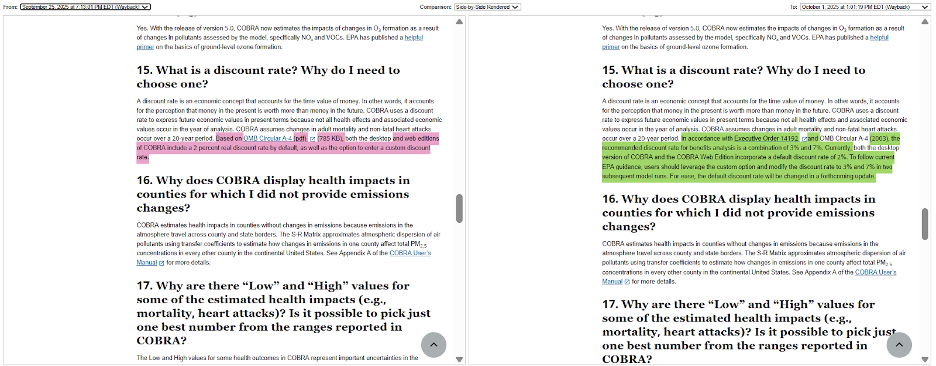
EPA’s page for “COBRA Questions and Answers” on September 25, 2025 (left), and October 6, 2025 (right).
Highlights From the Change Log:
Changes to EPA’s COBRA Tool Have Major Implications for Climate Policy
Welcome! This post is part of the EDGI Website Governance Team’s “Highlights From the Change Log” blog series. The purpose of this series is to highlight interesting changes we have observed in the content of, or access to, federal websites. We want to share these changes to encourage public engagement with and discussion of their significance, as well as understanding of the ephemeral nature of website information. These website changes happened in Fall 2025 and feature changes to information about EPA’s regulatory analysis.
Beware the Fine Print
EPA’s CO-Benefits Risk Assessment (COBRA) tool helps estimate the health and economic benefits of addressing air pollution. On September 30, the Environmental Protection Agency (EPA) revised its COBRA questions and answers page to instruct staff to use 7% and 3% discount rates, rather than the default 2%. EPA also removed a link to the 2023 guidance document that specified the 2% rate.
The discount rate is the rate at which future social benefits are discounted to determine their value today (see this helpful article). The larger the discount rate, the lower the value of future benefits, and the more likely it is that present-day costs outweigh the future benefits. This rate has significant impacts on cost-benefit analyses used to set policy, particularly climate policies for which benefits may not be seen until well into the future.
The updated discount rate EPA is instructing its staff to use reflects the directive in President Trump’s Executive Order 14192 “Unleashing Prosperity Through Deregulation,” which revokes the Office of Management and Budget’s (OMB) most recent (2023) Circular A-4 “Regulatory Analysis” and reinstates the 2003 Circular A-4. The 2023 and 2003 OMB Circular A-4 rules are explained in the following section.
Trump Reverses Biden’s Advances
The Biden administration sought expert peer review and public comment to revise the OMB Circular A-4, which guides agencies in conducting regulatory analyses, for the first time in 20 years. Based on leading research and extensive public input, the Biden administration updated the social discount rate from 7% and 3% for investment and consumption, respectively, to a uniform 2% in the 2023 Circular A-4 revision. Experts across economic and philosophy disciplines widely back this 2% discount rate, which make regulatory cost-benefit analyses much more favorable to policies that protect future generations.
President Trump tried to undo the Biden OMB’s evidence-based work with a stroke of the pen in EO 14192 section 6 (b), stating “The Director shall revoke OMB Circular No. A-4 of November 9, 2023 (Regulatory Analysis), and all accompanying appendices, guidelines, and documents, and shall reinstate the prior version of Circular A-4, issued on September 17, 2003.” However, experts pointed out that the Regulatory Right-To-Know Act requires that OMB guidance on cost-benefit regulatory analyses undergo peer review. Nearly 10 months after EO 14192 was issued, there has still not been a call for peer review or public comment on the Trump administration’s change. EPA has also not updated the COBRA tool’s default discount rate, which is still 2%, but instead instructs staff to manually input the updated rates while it updates the software.
This Change in Context
These web changes are a stark reminder of the many ways the Trump administration can implement its deregulatory agenda. In this case, it has rewound our approach to calculating future benefits for climate policy by 20 years with an Executive Order and subsequent changes to agency guidance evidenced in EPA’s website changes. Though seemingly innocuous, the discount rate changes found on EPA’s website are highly consequential and come as EPA proposes to rescind the finding that greenhouse gases endanger human health and wellbeing, get rid of the Social Cost of Carbon, and repeal the Greenhouse Gas Reporting Program. The administration’s efforts to undermine climate action are extensive and will have profound consequences for generations to come.