
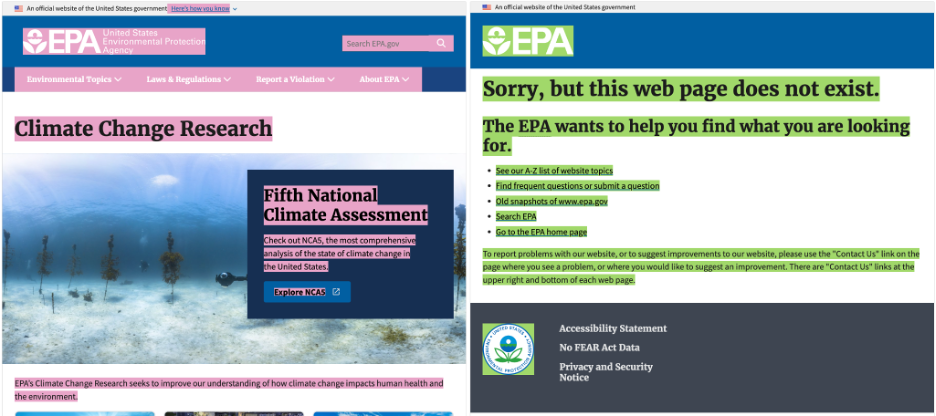
EPA’s homepage for Climate Change Research on September 8, 2026 (left), and September 10, 2026 (right), after it was taken down. Text highlighted in red was removed, text highlighted in green was added.
Highlights From the Change Log:
EPA’s Website on Climate Change Research Goes Dark
Welcome! This post is part of the EDGI Website Monitoring Team’s “Highlights from the Change Log” blog series. The purpose of this series is to highlight interesting changes we have observed in the language used on, or access to, federal websites. We want to share these changes to encourage public engagement with and discussion of their significance, as well as understanding of the ephemeral nature of website information. These website changes happened in September 2026 and involve the removal of EPA’s website dedicated to climate change research.
What Happened:
On September 10, 2026, the Environmental Protection Agency (EPA) took down its website dedicated to climate research. The removals spanned several webpages about research on the links between climate change and air quality, community resilience, ecosystems & water quality, energy, and human health. Several of the targeted webpages linked to external resources that remain on the web but are now less accessible. For example, one page linked to tools to help protect public health and the environment in the face of climate change, while another linked to resources such as the Fifth National Climate Assessment, EPA’s website about research milestones, and EPA’s climate change website. While these resources technically remain online, their public access is restricted through the removal of landing pages that navigate to them.
Why We Think It’s Interesting:
The research featured on this website explains how the climate crisis has concrete, definable, and addressable impacts for particular communities. Its removal hides these impacts. For example, EPA has historically dedicated research to understanding which communities are most vulnerable to climate impacts—research that informed interventions targeted at increasing local resiliency. Removing information about community vulnerability obscures the very real climate impacts these communities will experience, positioning climate change as an abstract issue rather than a practical problem affecting daily life.
The removal of information about climate change research also decouples scientific research from environmental decision-making and conceals the concrete steps necessary to mitigate climate impacts. For example, research explaining how certain air pollutants impact global heating can inform policies aimed at minimizing these pollutants. Research on the costs and benefits of renewable energy can inform policies aimed at an energy transition. Climate action is preceded by evidence, and the systematic removal of evidence and the ability to collect it in the future hamstrings meaningful climate action.
More broadly, the removal of information on climate research continues the administration’s pattern of censoring both climate change information and scientific research more broadly. EDGI has noted the removal of information about climate science, climate adaptation, climate resilience, the anthropogenic nature of climate change, climate indicators and impacts, and much more. The Trump administration has significantly weakened scientific institutions through not only information removals, but also reductions in force, executive orders and regulations, and countless other actions. Taken together, these actions indicate that the United States federal government is rushing down a path of willful ignorance and inaction to the ever-increasing gravity of climate change, placing people and the planet in harm’s way.